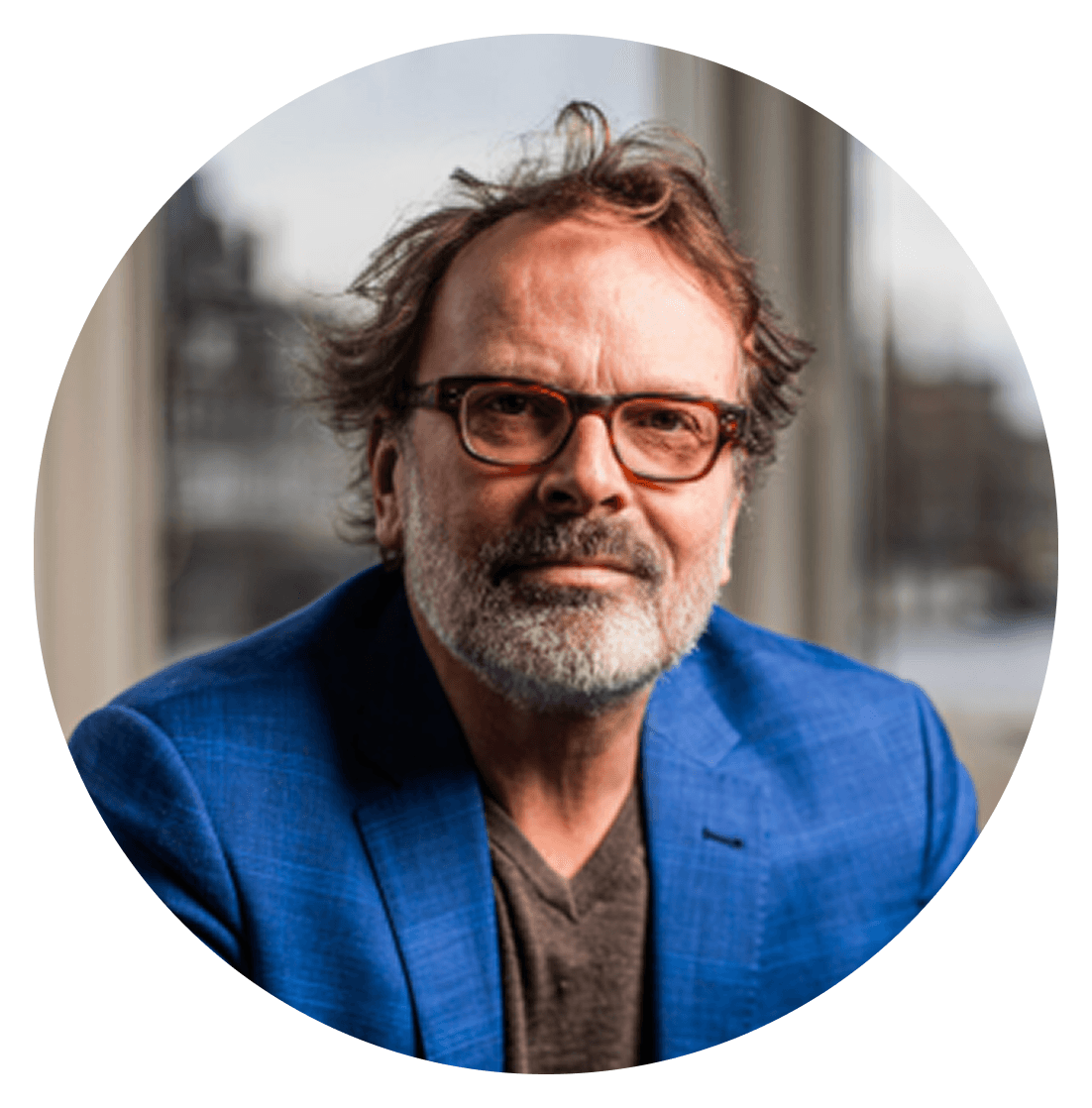
Marjan Slob
Philosopher

For eight, sometimes twelve hours, gamblers stand at their slot machines in the casinos of Las Vegas. Non-stop. They barely move, which of course increases the risk of blood clots and therefore heart attacks. Las Vegas ambulance crews dread getting a call to go to the casino. They know that they can hardly reach the patient there: the gamblers at the machines next to the player in distress often refuse to take even a single step aside to let them reach their patient. These gambling addicts do not respond to a fire alarm either. A regular customer says she consciously wears black clothes so it doesn't stand out when she pees her pants – she doesn't even want to leave her machine to go to the toilet.
I took this report about the lives of heavy gamblers from The World Beyond Your Head: On Becoming an Individual in an Age of Distraction by cultural scholar Matthew Crawford. I read this book years ago and have never forgotten the image of those gamblers. Philosophy examines the question of what a good life is, so what actually qualifies as a good life, and why. I don't have a definitive answer to that myself. Fine, of course; such a question is meant to remain a constant inquiry for a philosopher. But I do feel in every fiber of my body: the life sketched here of gamblers in Las Vegas is at least not the good life. Incidentally, the gamblers themselves think so too. Crawford portrays them as people who are not so much looking to win money, as you might think. Initially, that may have been the reason to go to the casino, but by now their goal is to ‘get into the zone’: the zone in which they reside with a machine that constantly responds to them. The response is the reward, not the money. Moreover, that response is fairly predictable, which makes ‘the zone’ manageable and therefore safe. The gambler is in control there, because the machine responds immediately to him and thus confirms his existence. Routine gamblers know full well that they are eventually going to lose money. But their point is that there is a predictable interaction between them and the machine. They enter a sheltered world, in which the machine ‘listens’ and embraces them.
I think this hellish image of Las Vegas's die-hard gamblers has stuck with me so much because it is an extremely concentrated version of an experience we all know: smartphone addiction. I don't consider myself a heavy user, but even I notice that the phone pulls at me. Unnoticed, it has crept in that in the evening I also check several times whether there are new messages, even though I actually long for calm. Of course, it is me walking to the phone – but the impulse is hard to resist. And with my eyes once fixed on the screen, Big Tech's software ensures that I can scroll endlessly to the next feed, that videos start on their own, that notifications pop up automatically, that a new ‘personalized’ suggestion follows for a product that I might also find interesting. I don't have to engage with any of it, but it requires self-control and action from me to resist all of that – even though I didn't ask for it.
Public space is also filled with messages that want to capture and hold our attention. Every empty space is filled with advertising – preferably moving because perceptual psychologists know that we humans have a biological, almost uncontrollable impulse to at least briefly look at movement. Even in the quiet carriage of the train, I have to actively turn my eyes away from moving commercials from the Dutch Railways (NS) – the equivalent of the waving hand on the savanna: pay attention, look here! Incredibly useful, of course, that we have a system anchored in our biology to break through someone else's activities. This allows us to alert a group member to something acute and important: a predator, a wandering child, a bush with ripe berries. But the alerting signals we are bombarded with daily, both at home and in public space, are nine times out of ten the equivalent of a false alarm. The agitation they cause gives you a brief feeling that you matter, that you participate in existence. You are basically absorbed into the kind of zone that gamblers crave. But just like in the casino, you are ultimately the certain loser. And what you lose is attention.
And what you lose is attention.
German neurophilosopher Thomas Metzinger puts it this way: our attention is ‘hijacked’ by ‘commercial attention robbers’. They emit ‘alerting signals’ that we find difficult to resist because of our biology. They siphon off our attention and convert it into money. And that is a serious loss. Because your reservoir of attention is finite, and that attention is crucial to leading a good life. Attention makes it possible for you to direct your life towards what you yourself find important. Attention is magical, because your life is determined by what you pay attention to.
The clearest definition of attention I know comes from my former Zen teacher Cornelia Wierenga. ‘This is focus’, she said (pointing her index finger). ‘And this is attention’, (and she spread her arms). Focus is important to reach your goal. Focus pulls you into the zone, a narrow space in which only you and your goal exist. Focus has a good reputation – and rightly so, because it makes you effective, directed, and steady on your course.
Attention, on the other hand, is about openness to your environment. By nature, attention is aimless. It is the gaze that grazes quietly and lingers briefly on whatever presents itself. Attention is receptivity: in an attentive state, your inner space can fill with new impressions, with unexpected sides of reality that may not fit your plan, but which are indeed happening. Attention is not about you and your little plans; it is about being open to what presents itself around you, and within you. Attention allows you to go beyond your usual way of organizing and doing things. It lifts you out of your routines for a moment, creating space for reflection.
So: why should you actually protect your attention? Why can't you get by on focus alone? Because attention allows you to guide your state of mind, your behavior, and ultimately your life to some extent in the
direction of your own values. Living according to your own values is what almost all philosophers consider necessary to lead a good life. And attention is therefore the key quality in this.
To gain insight into how this works, a brief excursion into neurophilosophy – the subject of my book Hersenbeest (Brain Beast). In it features the Nijmegen neuropsychologist Herman Kolk, who uses a simple example to make us feel what attention does. Kolk talks about an experiment in social psychology in which subjects are exposed to a series of pictures of elderly people. What turns out: after such a slide show, the subjects automatically walk slower for a while. The experiment thus says something about how we generally attune ourselves to our environment, and how we let ourselves be influenced by what we assume about the people around us. This effect exists, and it is statistically significant. But there are always exceptions.
‘It may well be’, Kolk told me, ‘that a subject who obediently looked at the pictures nevertheless rushes to a friend waiting for her at the exit after the experiment. At that moment she has a personal interest, and that impulse is many times stronger than the general impulse emanating from the pictures of the elderly.’ The urge to get to that friend as quickly as possible pushes away, as it were, the influence emanating from the pictures.
So there are two brain impulses: the impulse of the pictures and the desire to see that friend. The girl does exactly what the experimenter asks, but her attention is actually on that friend. Her attention isolates that brain impulse, as it were, so that impulse ‘wins’ – she doesn't shuffle to that friend, but rushes to him. By directing her attention to something that is important to her, she can therefore break with a general human pattern and deviate from routines.
Now this is, of course, a trivial example. But it is about the principle: attention ensures that you do not do the obvious, but that which is important to you. You can therefore guide yourself, as it were, by directing your attention to what you value. And that valuation immediately strengthens the impulse to actually do that special thing, causing other impulses (which are always there too) to recede and lose relative strength.
For those who enjoy this: this touches on a subtle but important point within the philosophical discussion on free will. The image that emerges here is not the classic one: ‘you pay attention to something, and then you decide to do what you pay attention to’. No: you pay attention, and that is the same as having the tendency to do what you pay attention to. That mental step of the decision can therefore be skipped. Deciding has become a meaningless concept here. You just do it; it goes hand in hand with having attention. Attention is not supervised by our decisions. Attention wells up from our body, which amplifies one impulse from all those impulses that are always simmering within us. The image is therefore not top-down, but bottom-up.
Modern brain research supports this view of things. It seems that the neuronal network in our brain that amplifies impulses (i.e. makes them last longer, lets them reverberate longer) and the neuronal network that values impulses (i.e. gives you the inner experience that something of importance to you is going on) are one and the same system. If so, ‘amplifying’ and ‘valuing’ are synonymous to our body. The physiological word ‘amplifying’ is, in another language game, in another, more everyday way of talking, the same as ‘paying attention’. And that amplifying takes place while your attention goes to what matters to you. Automatically. You don't have to decide on that. It happens by itself, bottom-up.
In short: what you attach importance to grows into a stronger, more sustained physiological impulse, which feels to you like attention. The same put the other way around: attention makes your behavior conform to what you are interested in. After all, you use it to amplify the impulses you consider important. And the strongest impulses win; that is how our biology works.
I realize this is quite technical. But my point is the following implication: you can train – reinforce – your impulses by keeping an image in mind of what matters to you. Imagine a boy who wants to become a good cello player. He loves the sound of the instrument, and perhaps dreams of playing a Bach cello suite (he is a well-behaved boy). That image fills him, makes him swell. Imagining himself as such a cello player is rewarding to him. And he knows that he will have to practice for that, that he will have to repeat certain actions endlessly to make them second nature. So he rehearses scales and master the correct posture of hand and bow – until something that is in fact an exceptional way of dealing with a piece of wood on which strings are stretched becomes the normal way of doing things for him.
See the link with that simple example of the pictures of the elderly versus the friend: this boy touches his cello differently than the rest of us mortals because he has placed more importance on that cello than we have. He has been able to break with the usual way untrained people handle such a cello. His love for the instrument, the value he attaches to it, now shows itself in his intimate handling of the instrument. Naturally.
And this example of the cello adds another element, namely time. This boy has had to practice a lot to get a beautiful sound out of his instrument. Think of those endless scales. And, even more importantly, think of all the other impulses he has had to resist. Often enough he might have liked to play video games or go mountain biking or hang out with friends – but he resisted those impulses because he kept that image of the cello player in mind and because this image was usually more motivating to him, and thus won often enough. In another, less scientized language game you would say: this boy can now play the cello well because he has dedicated himself to what he envisioned. And gradually that dedication has come to color his life. Until it doesn't even feel like an effort of will anymore. By consciously working on forming a habit, he has installed a kind of ‘second nature’ for himself. By now he no longer needs to motivate himself with that image of himself as a cello player; he longs for the cello itself.
You can tell when people's values have descended into their bodies. Watch how an experienced chef cuts an onion – precise, fast, almost automatic. The value that such a chef attaches to preparing food shows in his behavior. Another way of dealing with that onion is no longer an option. In a phrase by philosopher Simone Weil: he is ‘so attentive that he has no choice left’. Cutting an onion has become so natural that he no longer thinks about it himself, while at the same time it shows exactly what he stands for and what he finds important. The same applies to the caring gesture of a nurse, to the casual crossover step of the speed skater, and actually also to me when I sit on the couch in the morning with a blanket over my feet reading a nice, solid philosophy book. Picking up such a book has become part of my life.
And to now make a link with that search of philosophers for what makes a life good and worthwhile: you can not only practice scales, you can also explicitly practice values. Let me keep it to myself again. By nature, I am quite stingy and frugal. My tendency is to hoard rather than to spend. I do not give easily, whereas I find generosity a beautiful and admirable virtue – I ‘value’ generosity, I attach importance to it. When I get into a situation where generosity is called for, for example if I see a beggar on the street, my first impulse is still a kind of tightening: ‘no, I am going to pass this by.’ But because my valuation of the virtue of generosity also hums around somewhere inside me, I do hesitate for a moment. There is a counterforce. Perhaps even more important: I analyze and understand my world at that moment partly in the light of generosity – as a situation in which generosity is at stake. If I had not found generosity an important virtue, I would have walked past that beggar thoughtlessly. But now I see it as a situation where generosity is called for, and in which I could potentially practice generosity. By paying attention to that value which is important to me, I therefore create a situation in which I can overrule my basic impulses. ‘Hey Marjan, giving is called for here, and you could easily do that. Why not, actually?’ I am in dialogue with myself, and thereby reinforce that brain impulse.
Gradually, I have become a tiny bit more generous in my life. It still doesn't amount to much, but still, I have grown towards my value. Naturally. Because I interpret my environment with that value in the back of my mind. Every now and then I gain experience practicing generosity. And because of that, it becomes easier and more natural to be generous again. In that sense, I am increasingly leading the generous life I hope for. Thanks to my attention to that value.
When you pay attention to a certain inner impulse, you increase the chance that you will do not so much the most common, but the most appropriate thing. That you do not shuffle, but run. That you do not walk on, but donate.
The reverse is also true: inner impulses naturally lose (some of) their strength if you pay no attention to them. That reminds me of that famous fable about the two wolves that are said to live inside each of us. A wise man (in the colorful version, it is an old Native American) tells his grandson by the campfire that the good and bad impulses residing in each of us could be seen as two wolves fighting each other. One wolf stands for arrogance, self-pity, deceitfulness, greed, and so on. The other for everything that is beautiful in a human being: joy, loyalty, compassion, you name it. ‘Grandpa, grandpa, which wolf wins?’ asks the little boy. And the old man replies: ‘The one you feed.’ In my terms: the impulse you reinforce with your attention.
The path to that good life that philosophers have traditionally been looking for therefore runs through attention. Directing your attention is the most important tool you have to lead the life you yourself consider good. Attention enables you to set your own goals. From the inside out. Do that long enough, and gradually your life will conform to your values and goals.
This excursion into neurophilosophy makes that earlier observation by Thomas Metzinger, namely that our attention is ‘hijacked’ by ‘commercial attention robbers’, all the more poignant. All those intrusive sights and sounds act on us like an alarm. They basically scream: ‘drop everything you are doing yourself, there is something important going on here!’. That is not only annoying and distracting, but also hinders you in your attempt to shape your life according to your own values, to become who you hope to be. Dedication and a steady and long-term practice are crucial to becoming someone, to growing into someone who stands for something. And in that you are constantly interrupted. I don't really understand why we allow this, knowing that it is already hard enough for people to actually heed the impulses of their better selves. I don't want to sound too alarmist, but all that attention-grabbing coming at you from the outside world breaches the already quite precarious ability to mold your life according to your own insight to your own values.
Claiming space to shape your life according to your own insight – isn't that the core credo of liberalism? Seen in this light, it is incomprehensible that a liberal party that has governed almost continuously for twenty years has not put a stop to the rise of attention robbers that thwart precisely that liberal ideal. I would expect any government within a liberal democracy to see protecting everyone's individual capacity for attention as a public duty.
The social debate about digital technologies is rightly often about privacy. Protecting privacy usually means that your personal data may not just be scattered everywhere. That is important. But to me, privacy is much more: having the right to an inner space of my own, where I can figure out and decide for myself what is important to me, what matters to me. That is where what is of value to me grows. If I can set up that space the way I find beautiful, and shape myself according to my own values and views, and get the time to strengthen, reinforce, and automate the corresponding impulses, then I touch upon the good life in a philosophical sense. And precisely that is being squeezed.
Advertising is of course of all times, but by now it also invades our private space via TV, PC, tablet, and smartphone, meaning you are bombarded even more often and, moreover, in your own place with the interests of others. A bombardment of distraction comes at you, exploiting your primary inclinations and desires for the benefit of god knows which shareholders. And you are expected to remain well-behaved and sensible. You have to control yourself. The only thing policy counters this with is a completely superficial slogan: ‘people choose this themselves’. It is enough to make you furious: so loveless, so stupid, so uncaring. Why do we allow these intrusions by companies aimed not at the good life, but at profit? Salty food gets an unhealthy label, toxic substances are flat out banned. I think there should be rules protecting our reservoir of attention. I want to be able to use my attention as much as possible when and how I see fit. Because I want a good life according to my own insight.
Marjan Slob
Published in De Correspondent, December 2023. Copyright Marjan Slob.