
Hans Schnitzler
philosopher and writer
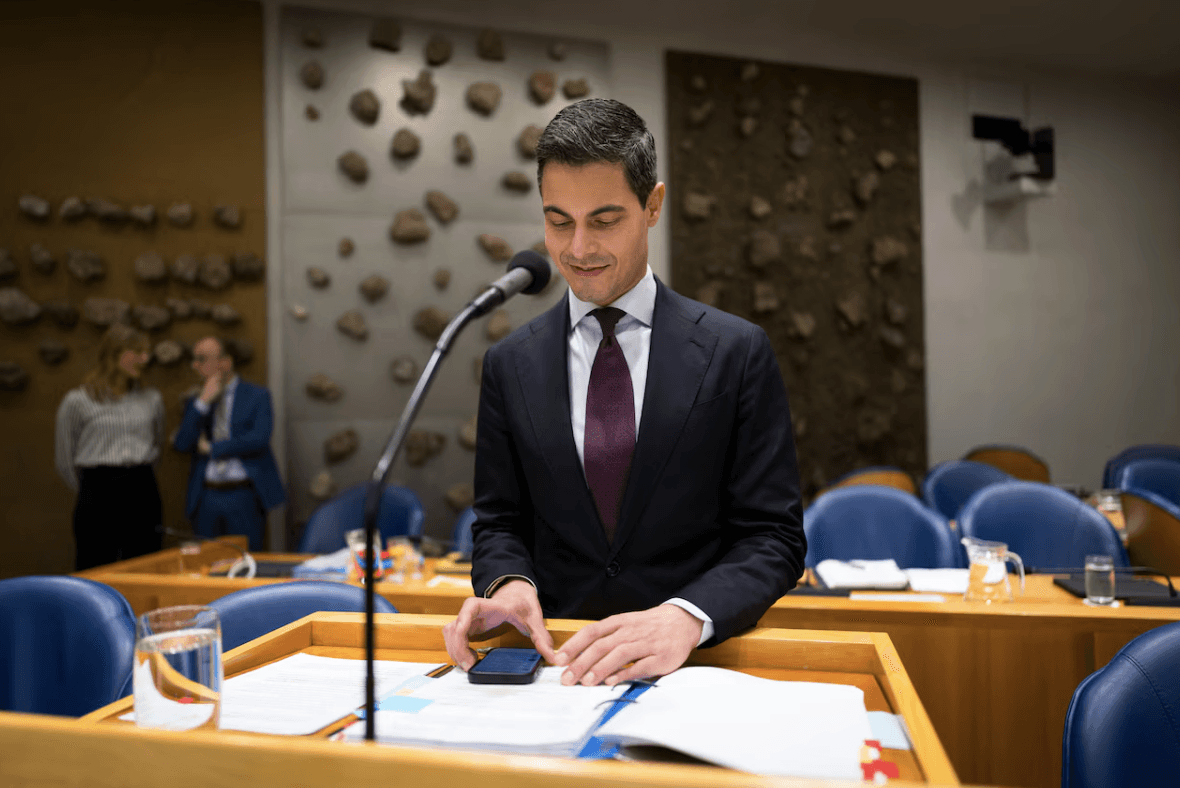
Photo: David van Dam / de Volkskrant
It has by now become a familiar and almost iconic image: PVV leader Wilders staring stoically at his smartphone while a fellow Member of Parliament delivers a speech that concerns him. But Wilders is by no means an exception. Observe an average debate in the plenary chamber of our parliament and rest assured that pretty much half of the MPs are glued to their screens during the debates.
This is problematic for several reasons and ultimately comes at the expense of something like a democratic ethos. Such an ethos refers to an individual and collective basic attitude in which values such as engagement, responsibility, and respect are central. More generally, a democratic ethos stands or falls with the ability to take a concept like human dignity seriously and to want to give substance to it.
As soon as we do not deign to give the other a worthy look, that dignity is compromised. And that is exactly what happens as soon as, in the preeminent talking house – the parliament, derived from the French 'parler' which after all means to talk – the customs of conversation are trampled upon by ignoring the gaze of the conversation partner. 'Look at me when I speak to you' is a form of civility that most of us were spoon-fed from an early age, but for which an exceptional situation apparently applies in the house designed for conducting conversation.
The House of Representatives is no ordinary meeting room, and the screen mentality of our MPs is more than just a matter of manners. A healthy democratic dialogue cannot do without paying attention, which is to say: that special form of engagement that makes it possible to see and hear the Other in order to look and listen beyond one's own perspective. The French thinker Simone Weil called attention the 'purest form of generosity'. This definition is so striking because it makes clear that by paying attention to something or someone, you are, as it were, giving yourself away. Paying attention to something means that you keep your own presence in check out of a desire to give the other room to thrive.
Anyone who disregards this dynamics of attention dismisses the voice of another and hollows out the democratic ethos. All in all, a huge responsibility rests on MPs to resist the smartphone during plenary sessions; not only to set a good example, but also to protect their own capacity for attention. After all, the smartphone is the vehicle par excellence for an attention industry – read: Big Tech – which is bent on hijacking our attention from the here and now and catapulting it to an everywhere and nowhere. That is not without consequences, because attention – and we often forget this – is a human resource, just like water and air. And where clean air lets us breathe, pure attention lets us think and feel.
'Attention is the bridge that connects us', states the foundation 'Attention for attention' in its recently launched campaign for a smartphone-free House of Representatives. An initiative that deserves all support, especially in times when democracy-hostile tech bros are doing everything they can to blow up that bridge. In short, dear MPs, do yourself and us a favor, take your attention management seriously and ban the smartphone from the plenary chamber.
Hans Schnitzler is a philosopher and writer.
Source: https://www.volkskrant.nl/columns-opinie/opinie-verban-de-smartphone-uit-de-tweede-kamer~b49f6d5a/

