
Jeroen Alexander Meijer
A smartphone-free House of Representatives
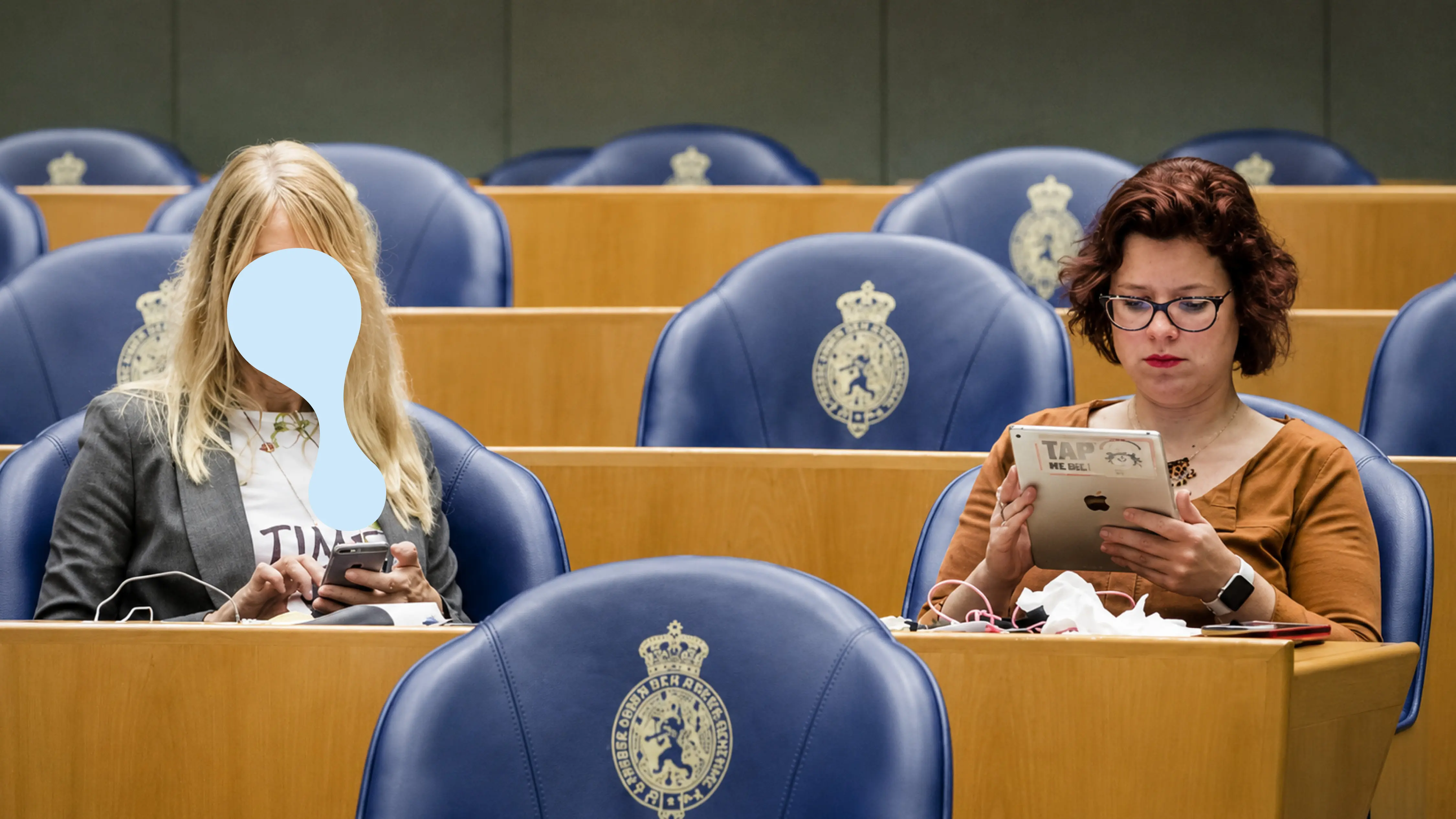
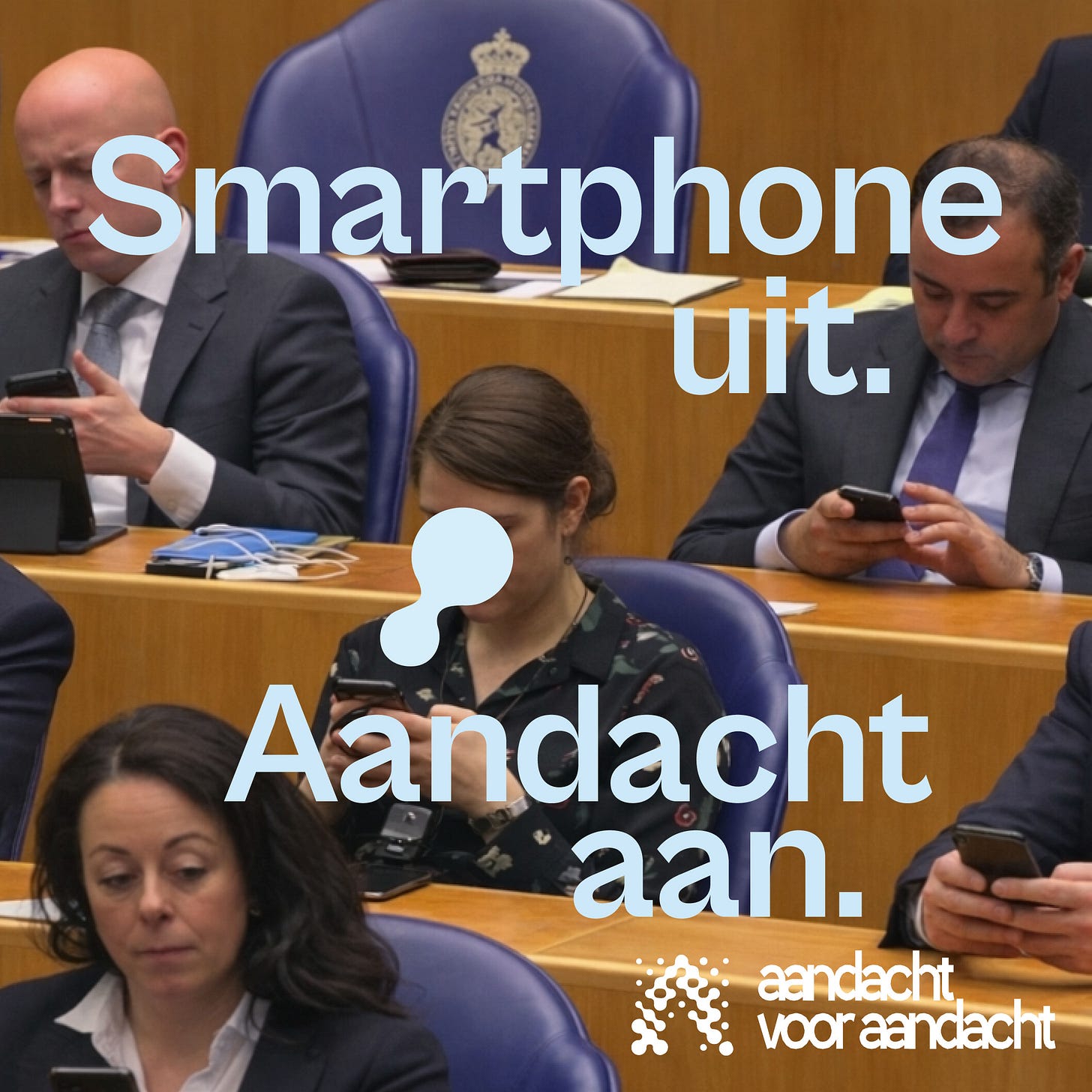
Take a look at any debate. Not at the speaker, but at the benches in front of them. At the faces looking down, the hands holding a device, the thumbs moving. It has become a familiar sight. So familiar that we almost don't notice it anymore.
We want to propose that things can be done differently.
Attention for Attention advocates for a Smartphone-free House of Representatives. No phones in hand during the debate. Not even phones in the room. Not because we are against technology, and not because we want to cut off representatives from the world. But because the place where our laws are made deserves the full attention of the people responsible for them. And because that place, whether we like it or not, serves as an example for the rest of the country.
What it is about
A debate is not a formality. It is the place where arguments are weighed, where a minister is questioned, where a member of parliament defends or dismantles an amendment. It requires listening. It requires presence of mind to test an answer the moment it is given, and not just when reading it back later.
That kind of attention is certainly not a given. It is an achievement. And it is precisely the kind of achievement that a smartphone undermines, in a way that goes deeper than most people suspect.

The phone costs attention, even when you are not using it
Attention researcher Adrian Ward and his colleagues at the University of Texas conducted a series of experiments with nearly eight hundred people. The setup was simple. Participants completed tasks that tested their working memory. The only variable: where was their phone? On the desk, in their bag, or in another room.
The outcome was a straight line. The closer the phone, the less thinking space people had left for the task. Having the phone in another room yielded the best performance. And this happened even when the device was turned off.
The researchers called it "brain drain." Even when people successfully kept their attention focused and did not look at their phone, the mere presence of the device reduced their available thinking space. The explanation is beautiful and uncomfortable at the same time. Not thinking about your phone is an effort in itself. Your brain has to actively keep an attractive, important object out of your consciousness, and that costs exactly the attention you need for your work.1
Honest about the science
Now we must confess something, because an argument that conceals its own weak spots is not an argument but a sales pitch.
The brain drain research is not without controversy. A direct replication with the same tasks and conditions did not find the effect. We must be honest about that. Since then, multiple meta-analyses have tried to take stock, and the picture that emerges is narrower than the original claim, but it does not disappear. The common thread: the effect is concentrated on working memory. Not on everything, but on precisely that one thing you need to follow a live debate and form your own judgment on it.2
So let's make the claim as sharp and as honest as possible. We do not know for sure that a phone on the table depresses your cognition in general. We do have good indications that the device burdens your working memory, and working memory is precisely what parliamentary work relies on.
The role model function
And then there is something larger than thinking space and working memory.
The House of Representatives makes laws about screen use. Since January 2024, there has been a ban on phones in classrooms, and the first results are remarkably positive. Teachers and school leaders from nearly six hundred secondary schools report that students interact more socially with each other and follow lessons with more concentration.3 We ask children to protect their attention during school hours. We ask parents to set boundaries at home.
In those schools, something beautiful is happening. Teachers are aware of their role model function, and if they reach for their phone themselves, they are called out by students. The child holds the adult to the standard. That is exactly how it is supposed to work.
But in the hall where those laws are made, representatives debate with phone in hand. That undermines the credibility of every measure they propose to society. If we expect a twelve-year-old to put away their phone to concentrate, we should expect the same from someone who makes laws for seventeen million people.
This line of thought is not new. Already fifteen years ago, in 2011, philosopher and publicist Hans Schnitzler argued that mobile phones should be banned from every school, because school is the place where the battle for attention is fought.4 And he did not stop there. He immediately extended the line to politics. Perhaps, he wrote, it helps if politicians take the lead in this. Let them stop tweeting and emailing during parliamentary debates. That too is a matter of attention. And of courtesy.
The fact that he wrote this in a time of BlackBerrys and the first smartphones, long before a school phone ban became a reality, only makes it more striking. What was then a prescient observation is now policy in every classroom. Only the House of Representatives itself lags behind.
The place where the people are represented should be the epitome of the attention we ask of everyone.

The counterargument
In our research into why politicians are on their phones so often, we keep coming across the same argument. Namely, the following:
"We need to be able to be in contact with our advisors during a debate."
For this, they are in countless chat groups with experts on every dossier.
It is a good argument, and it comes from the members of parliament themselves. Most of them are not scrolling, they say. They are consulting. A text message from a spokesperson, a quick check with the dossier holder, a response whispered from the sidelines. That is how it works, and without that line to their staff, they cannot do their job.
We completely believe and understand that! And yet we believe that this very argument shows why the smartphone can be banned from the House.
Because suppose it is true. Suppose a member of parliament really only uses the phone to consult. Even then, they are in exactly the state that the brain drain research measures: device present, attention nominally on the debate, working memory quietly burdened. "I only use it for work" is not an exception to the effect. It is the experimental setup.
And more importantly: consulting with advisors can also be done differently. It can be done via a laptop on the table.
The difference lies in the device. A laptop on a meeting table is placed in a work context. It is detached from your body. You glance at it occasionally, read a document, type a note. A smartphone is something else. You hold it with two hands, close to your chest. It vibrates with infinite notifications in your pocket. It is increasingly built to grab your attention, not to help you work, and it carries the entire attention economy with it: the notifications, the apps, social media, games, and so on.
Reading a text message on a phone, half under the desk, turned away from the camera, is precisely the secretive posture that undermines the debate. That same message on a laptop is open on the table. Visible. In a working posture. Reading documents, typing, making notes, keeping in touch with the faction: for each of these tasks, the laptop is the better tool.
What we are actually asking
So we are not banning contact with advisors. We are not banning preparation, nor the expertise of the dossier holders, nor the help of the spokespersons. All of that can remain, open and visible, on a laptop on the table.
We are banning the device. The device that distracts us. That carries the attention economy into the room. That burdens the working memory, even when it lies silently in a bag. And that sends the wrong signal to a country that looks at the House and wonders if the people there are actually listening.
A laptop on the table says: I am working. A phone in hand says: I am elsewhere.
The difference is visible. And it is seen by all of us.
Join in
A Smartphone-free House of Representatives is not a radical idea. It is the same standard we already ask of our schools, applied to the place where that standard is devised. It is a matter of credibility, of debate quality, and of the kind of attention that a democracy deserves.
Do you want the House to set a good example? Then support the call for a smartphone-free House of Representatives. Share this article. Follow the campaign. And if you have an entry point to a member of parliament or a faction: make yourself heard. Change often begins with one representative who puts the phone away and says: from now on, we do things differently.
The attention we ask of our children, we may also ask of ourselves. Especially in the place where the people are represented.
Sources
1 Adrian F. Ward, Kristen Duke, Ayelet Gneezy & Maarten W. Bos, “Brain Drain: The Mere Presence of One’s Own Smartphone Reduces Available Cognitive Capacity,” Journal of the Association for Consumer Research 2, no. 2 (2017): 140-154.
2 "Reexamining the 'brain drain' effect: A replication of Ward et al. (2017)," Acta Psychologica (2022). This direct replication with the same tasks found no difference between phone positions: https://www.sciencedirect.com/science/article/pii/S0001691822002323. Later meta-analyses show a narrower picture: the effect is concentrated on working memory, while no effect is often found for other cognitive functions.
3 Ministry of Education, Culture and Science, representative measurement among nearly six hundred secondary schools on the national agreement to ban mobile phones from classrooms (in force since January 2024); carried out by research agencies Kohnstamm and Oberon. Teachers and school leaders report more peace, more social behavior, and more concentrated lessons.
4 Hans Schnitzler, "Mobile phones should be banned from every school," de Volkskrant, June 3, 2011.